
The Darfur Conflict: The What, Who and Why

The Worrisome State of Africa’s Internet Speed
February 28, 2023
South Africa’s Post-Apartheid Era: The Current State of Things
March 3, 2023
Starting in 2003, a conflict has been raging in Sudan’s western region of Darfur. Hostilities began when the Sudan Liberation Movement (SLM) and the Justice and Equality Movement (JEM), took up arms against the Sudanese government for oppressing Darfur’s non-Arab population.
The conflict quickly escalated into a full-blown civil war, with both sides committing atrocities against the civilian population.
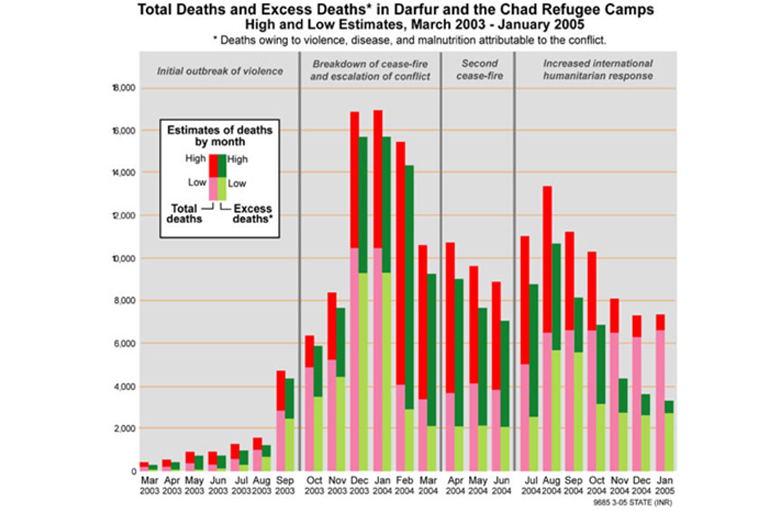
United Nations (UN) estimates that over 300,000 people lost their lives in the Darfur conflict. In this article, we explore the causes of the hostilities, the nature of the violence, and the international community's role in resolving the conflict.
The war in Darfur is not just a matter of civilians rising up against the Sudanese government for being marginalized. Much of the fighting takes place between the communities native to the region, while the Sudanese government has supported select groups against others.
Fighting takes place in a context of fierce competition over scarce resources and land. Aggression is also motivated by deep grievances over past violent actions, the cycle of revenge killings being one of the reasons for the war enduring for such a long time.
Rather than try and mediate between the warring parties, the Sudanese government has throughout the majority of the conflict, played a dividing role by supporting the Janjaweed, an Arab militia group of camel and cattle herders.
The Janjaweed and Sudanese government forces are amongst the groups responsible for some of the conflict’s most atrocious actions against civilians.
Starting in 2013, the Sudanese government under President Omar al-Bashir incorporated Janjaweed militias into its military apparatus, establishing a paramilitary organization called the Rapid Support Forces. Civilians in Darfur have attributed many raids and killings to the Rapid Support Forces.
The humanitarian consequences of the Darfur conflict have been devastating. The Rapid Support Forces, for example, are reported to have engaged in the burning of villages and the rape and execution of civilians. Displacement of the population has also created widespread food insecurity, with many people being forced to rely on humanitarian aid to survive.
One of the major challenges in protecting civilians in Darfur has been the lack of access to humanitarian organizations and the international community. The Sudanese government has periodically obstructed the work of NGO’s and international organizations by limiting access to the region. Insecurity also makes it difficult for aid workers to operate, with many being targeted by combatants.
Since the conflict started in 2003, the international community has sought ways to end the hostilities in Darfur. Initially, however, efforts to resolve the Second Sudanese Civil War took precedence. As such, the United Nation should have held the Sudanese government accountable and spent limited attention on Darfur until a peace agreement between the North and South was signed in 2005.
The African Union Mission in Sudan (AMIS) was the first peacekeeping force sent to Darfur. AMIS was tasked with monitoring the conflict and providing protection to civilians. 150 Rwandan forces were deployed in August of 2004, but the mission expanded to 7,000 soldiers by April 2005.
The Sudanese government objected when the UN wished to join the African Union (AU) in sending forces to Darfur. It was only under the guise of a joint enterprise with the African Union that UN peacekeeping forces were granted permission to enter Darfur. The UN Security Council approved the African Union-United Nations Hybrid Operation in Darfur (UNAMID) for deployment on the 31st of July 2007.
UNAMID operated in Darfur until June 2021, achieving success in protecting civilians and negotiating peace agreements. Despite the efforts of UNAMID, however, the conflict continues unresolved and the humanitarian situation has remained dire.
The decision to end UNAMID followed years of pressure from the Sudanese government and a desire of participating countries to cut costs. Since peacekeeping forces left, there has been an increase in attacks reported.
Sadly, the war in Darfur is far from being resolved. While Omar al-Bashir, the man responsible for much of the conflict’s tragedies, was deposed by the army in 2019, no stable government capable of restoring order in Darfur has since materialized.
Following yet another coup by the army in 2021, Sudan currently finds itself in a state of political fragmentation. The country is in the midst of a two-year transition process leading to elections, facilitated by the UN, AU, and the East African bloc (IGAD). In all likelihood, large efforts to resolve the Darfur crisis will not occur until a new government is elected.
The Rwandan Renaissance: Paul Kagame’s Success Story

 English
 Arabic
 English
 French
 German
 Hausa
Hausa Igbo
Igbo Portuguese
 Shona
Shona Spanish
 Swahili
 Yoruba
 Zulu
Zulu