
The ASUU Strike: A Prelude to Greater Inequality in Nigeria

Africa’s Longest Living People: Life Expectancy in Algeria
January 11, 2023
Cooling Africa: The Kigali Amendment Against Global Warming
January 21, 2023
When two elephants battle, the grass suffers. Many Nigerian students will identify with this proverb as they feel they have been trampled upon by forces greater than them. Like most students worldwide, their education was on hold as part of the outfall of the coronavirus pandemic. However, their plight continued after universities in other countries had long reopened their doors.
On February 14, 2022, lecturers of the Academic Staff Union of Universities (ASUU) went on strike. As a result, students enrolled in Nigeria’s public universities did not see a classroom for the following eight months. The standoff between lecturers and the government only ended in October, when some of the lecturer’s demands were met.
The recent strike, though lengthy, was not unique. Lecturers laid down work nine times in the last 13 years. As for the ASUU, the union launched strikes as early as 1988. The government declared the ASUU illegal that year and seized its property. It was allowed to operate again in 1990, but following another strike, the government banned the organisation again in 1992. Indeed, it is no secret that the ASUU and the Nigerian government have a history of feuding.
Historically, lecturer strikes in Nigeria have been motivated by many reasons, including but not limited to reinstatement of dismissed colleagues, allegations of the government not honouring its promises, funding for education, demands pay raises, and dissatisfaction about the retirement age.
Central to 2022’s ASUU strike were demands for the release of allowances to lecturers, the amendment of a law that allows for the rapid establishment of new universities, and changes to the government payroll system.
The lecturer’s demand to limit the establishment of new universities has to do with government and state policy focusing on increasing the quantity of universities rather than improving the quality of existing institutions.
The lecturer’s interest in limiting the establishment of new universities is clear. They don’t want the education budget to be spread even wider, as they claim that existing facilities and personnel are already underfunded.
As for the government payroll system, lecturers resist it because they claim it does not capture specific allowances and places them at the government’s behest. Moreover, rather than being paid through their university, the system makes lecturers dependent on the accountant general of the federation to receive their salaries.
The government’s reaction to 2022’s ASUU strike was resolute. It did not give in to the lecturer’s demands for months. Eventually, it conceded on the issue of the release of allowances and increased funding for education. President Buhari announced that the government would invest $1.1 billion in universities in 2023 as per the agreement reached with the ASUU.
Though the law on the proliferation of new universities remains unaffected, the government payroll system will be subject to changes to appease lecturers. While the extent of these changes remains unclear, elements of a solution thought of by the ASUU will be implemented in the system.
While many students were happy to resume their education finally, much damage has likely been done by the pandemic and lecturer strike breaks of recent years. For example, students enrolled in a four-year degree will probably spend more than six years to graduate.
The extra time spent in university will set many students back financially. In addition, the breaks increased inequality—only the public universities were affected by the strikes. In contrast, private universities continued operating as normal. This means that wealthier students gain an even greater head start in life as they graduate up to two years earlier than their less affluent peers.
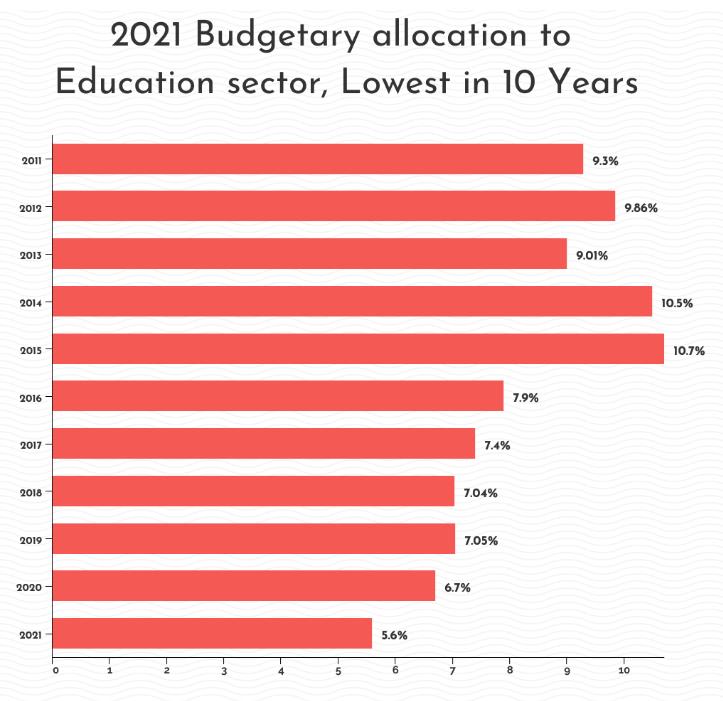
The Nigerian government has recently dedicated a decreasing budget to education. While 10.7% of total government expenditure was spent on education in 2015, the allocated funding had fallen to 5.6% by 2021. This disproportionally affects the nation’s poor. While the wealthy send their children to private universities or abroad, the poor face the consequences of lecturer strikes and a drop in educational standards due to budget cuts.
The resolution of the 2022 lecturer strike in October will not end the debacle. Soon after that, in November, the ASUU chairman said lecturers would observe lecture-free days as a statement of displeasure with the government.
The ASUU Strike: A Prelude to Greater Inequality in Nigeria

 English
 Arabic
 English
 French
 German
 Hausa
Hausa Igbo
Igbo Portuguese
 Shona
Shona Spanish
 Swahili
 Yoruba
 Zulu
Zulu