
Cooling Africa: The Kigali Amendment Against Global Warming

The ASUU Strike: A Prelude to Greater Inequality in Nigeria
January 12, 2023
Increasing Mobility in Africa: Volkswagen’s Strategy in Rwanda
January 21, 2023
Until recently, people’s refrigerators and air conditioners emitted chemicals that destroyed the earth's protective ozone layer. Recognizing the danger of the situation, countries came together in the 1980s to think of a solution.
The Montreal Protocol was signed in 1987 to preserve and restore the ozone layer. As a result, participating countries agreed to phase out chlorofluorocarbon (CFCs) gases causing ozone depletion. Since then, cooling machinery emitting CFCs has been primarily replaced with equipment emitting hydrofluorocarbons (HFCs).
HFCs do not destroy the ozone layer because they do not contain chlorine and have thus been utilized to replace CFCs under the Montreal Protocol.
HFCs, however, do contribute to global warming. For example, the five most commonly used HFCs are between 150 and 5,000 times more potent greenhouse gasses than CO2, trapping a lot of heat in the atmosphere.
If nothing is done, HFC emissions are projected to increase fivefold by 2050 from 2015 due to increasing demand for refrigeration and air conditioning.
Representatives of the Montreal Protocol have been negotiating HFC reduction proposals, culminating in the signing of the Kigali Amendment in 2015. As a result, 147 countries have ratified the protocol to achieve an 80% reduction in the production and consumption of HFC by 2047. If successful, this will prevent global temperature increase by 0.5 degrees Celsius.
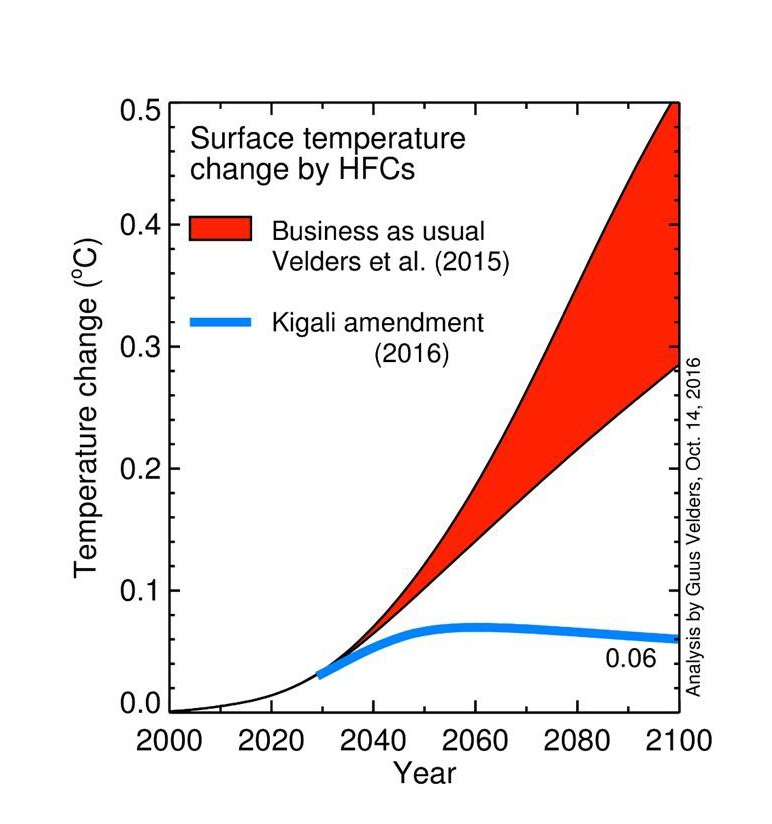
Africa has a vital role in limiting HFC-related global warming. The continent’s many developing countries account for an essential share of the increasing demand for refrigeration and air conditioning. As such, it is vital that African countries transition to climate-friendly alternatives to HFC-emitting cooling equipment.
Since few manufacturers of refrigeration and air conditioning items operate in Africa, changing the production end of things will, for the most part, befall exporters in China, Japan, Europe, and the USA. However, for African countries, there lies a role in ensuring that equipment with low global warming potential (GWP) is used within their territories.
For example, establishing bilateral agreements with countries that export refrigeration and air conditioning equipment will be important. In addition, national registration systems, licensing systems, product databases, and legislation prohibiting the sale of high GWP equipment will need to be put in place. If this is done, older refrigeration and air conditioning items will, over time, be replaced by cleaner alternatives.
In Africa, the illegal import of high GWP equipment poses a challenge. The continent’s often porous borders allow for mixed refrigerants, unnatural substances sold as refrigerants, improper drop-ins, and incorrectly labelled substances to enter countries unnoticed. To achieve the Kigali Amendments goal of reducing the production and consumption of HFC by over 80%, African governments must address this type of illegal smuggling.
In addition, African technicians should be taught about new green equipment and receive training to operate it. Older refrigerants will continue to be used if this still needs to be done, as they remain the only available option.
Involving Africa in the switch to low GWP cooling equipment will require close coordination between governments, international organizations, and manufacturers. There is broad support for the Kigali Amendment, with organizations like the UN and the EU involved in the transition. The parties must act in unison to ensure that Africa cools sustainably.
Cooling Africa: The Kigali Amendment Against Global Warming

 English
 Arabic
 English
 French
 German
 Hausa
Hausa Igbo
Igbo Portuguese
 Shona
Shona Spanish
 Swahili
 Yoruba
 Zulu
Zulu